
Introduction
“Are fistula and piles the same condition?” This is one of the most frequently asked questions at Dr. Trisha Rai’s clinic in Noida. It is an understandable confusion. Both conditions affect the anorectal area, both can cause discomfort and bleeding, and both are considered sensitive topics that people are reluctant to discuss openly. In this blog, Is Fistula and Piles the Same?, we clear the confusion and explain the key differences between these conditions.
However, fistula and piles are entirely different conditions with different causes, symptoms, appearances, and treatment approaches. Confusing the two can lead to delayed or incorrect treatment, which is why understanding the difference is so important.
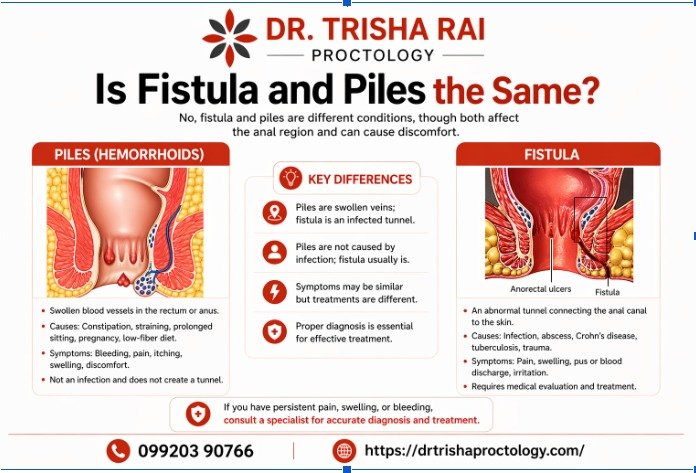
What are piles (hemorrhoids)?
Piles, medically known as hemorrhoids, are swollen and inflamed veins located in the lower rectum or around the anal opening. They develop when the blood vessels in the anal canal come under excessive pressure typically due to chronic constipation, straining, pregnancy, or prolonged sitting.
Piles are classified into two types based on location. Internal piles develop inside the rectum and are usually painless but cause bleeding. External piles develop under the skin around the anal opening and can be painful, itchy, and swollen.
What is an anal fistula?
An anal fistula is an abnormal tunnel-like passage that forms between the inside of the anal canal and the skin surrounding the anus. It almost always develops as a complication of an anal abscess, a pocket of infection that has not healed properly. The tunnel becomes a chronic pathway for bacteria and discharge.
Unlike piles, which are vascular in nature, fistulas are structural; they are physical passages through tissue that should not exist.
Key Differences Between Fistula and Piles
| Feature | Piles | Fistula |
| Nature | Swollen blood vessels | Abnormal tunnel in tissue |
| Primary Cause | Pressure on anal veins | Unhealed anal abscess |
| Bleeding | Common bright red | Occasional mixed with pus |
| Pain | Mild to moderate | Persistent, throbbing |
| Discharge | Mucus occasionally | Pus, blood-stained fluid |
| Lump | Yes, soft, bluish | Possible opening on skin |
| Fever | Rare | Common during infection |
| Self-Healing | Possible in early stages | Almost never |
| Treatment | Conservative to surgical | Usually requires surgery |
Symptoms: Piles vs Fistula
Piles’ Symptoms
- Bright red bleeding during bowel movements
- Itching or irritation around the anal area
- Pain or discomfort, especially while sitting
- Swelling around the anus
- A soft lump near the anal opening
- Feeling of incomplete evacuation
Fistula Symptoms
- Persistent throbbing pain around the anus
- Discharge of pus or blood-stained fluid near the anal opening
- Swelling, redness, and warmth around the anus
- Recurring anal abscesses
- Fever and fatigue during active infection
- A visible external opening on the skin near the anus
Can a Person Have Both Piles and Fistula?
Yes, it is possible to have both conditions simultaneously, though they are unrelated. A person with chronic piles and long-standing constipation can also develop an anal abscess that progresses to a fistula. This is why a thorough examination by a specialist like Dr. Trisha Rai is essential; self-diagnosis based on symptoms alone is unreliable.
Treatment Differences
Piles in early stages can often be managed conservatively with dietary changes, topical creams, and sitz baths.
Anal fistulas, on the other hand, almost always require surgical intervention. and fistulotomy are common procedures. In conjunction with VAFT and laser treatment, add DLPL and Filac. Also, unlike piles, fistulas do not respond to conservative treatment alone.
FAQ:
Q: Can piles turn into fistulas?
A: No. Piles and fistulas have different origins. However, the chronic straining and inflammation associated with piles can indirectly increase the risk of anal abscess formation, which may eventually lead to a fistula.
Q: Is the bleeding in piles and fistulas the same?
A: No. Piles typically cause bright red bleeding that is separate from stool. Fistula discharge is usually pus-like, sometimes mixed with a small amount of blood, and comes from the fistula opening on the skin rather than during bowel movements.
Q: Which is more serious, piles or fistula?
A: Both require medical attention, but fistulas are generally considered more complex because they involve an abnormal passage through tissue and almost always require surgery. Piles can sometimes resolve with conservative treatment.
Q: How is a fistula diagnosed differently from piles?
A: Dr. Trisha Rai uses clinical examination, proctoscopy, and in some cases MRI fistulogram to accurately diagnose and map a fistula. Piles are usually diagnosed through clinical examination and proctoscopy alone.
Q: Can I treat fistulas or piles at home?
A: Home care can temporarily relieve symptoms but cannot cure either condition permanently. Professional diagnosis and treatment are essential for both.