
Introduction
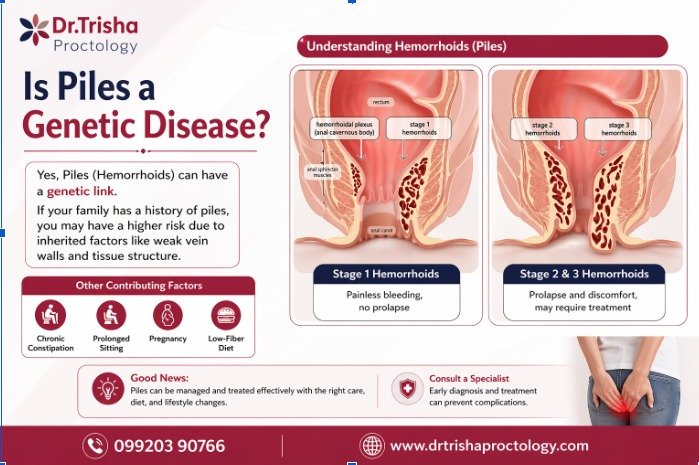
“My father had piles; my grandfather had piles. Am I going to get it too?” This is a question Dr. Trisha Rai hears regularly at her clinic in Noida. It is a valid concern, and the answer is nuanced. While piles are not purely a genetic disease, there is strong evidence that genetic factors do play a role in determining who is more susceptible to developing them. In this blog, Is Piles a Genetic Disease?, we explore how genetics and lifestyle both contribute to the risk.
Understanding the genetic and lifestyle components of piles helps you take proactive steps to reduce your risk even if your family history is working against you.
What are piles?
Piles, or hemorrhoids, are swollen, inflamed veins in the lower rectum or around the anus. They develop when increased pressure weakens the supporting tissues of the anal veins, causing them to swell and sometimes prolapse. They are among the most common anorectal conditions globally, affecting an estimated 75% of people at some point in their lives.
The Genetic Component of Piles
Research suggests that a family history of piles significantly increases individual risk. Several genetic factors contribute to this:
Connective Tissue Weakness: The structural integrity of veins and surrounding tissues is partly determined by genetics. People who inherit weaker connective tissue have veins that are more susceptible to swelling and prolapse under pressure.
Vein Wall Weakness: The tendency for vein walls to dilate and weaken under pressure, a characteristic of varicose veins and hemorrhoids, has a hereditary component. If your parents had varicose veins, you are at higher risk for both varicose veins and piles.
Digestive Tendency: Genetic predisposition to slower gut motility or chronic constipation can run in families, indirectly increasing piles risk across generations.
Body Weight Tendency: Obesity is a significant risk factor for piles, and genetic predisposition to weight gain can therefore indirectly increase piles risk.
Lifestyle Factors That Trigger Piles (Regardless of Genetics)
While genetics loads the gun, lifestyle pulls the trigger. The following factors are responsible for triggering piles even in people without a strong family history:
- Chronic constipation from a low-fibre, low-water diet
- Prolonged sitting, especially on the toilet
- Sedentary lifestyle with minimal physical activity
- Obesity and excess body weight
- Pregnancy and childbirth
- Heavy lifting that increases intra-abdominal pressure
- Chronic cough or straining due to other medical conditions
- Aging tissues weaken naturally with age
Does Having a Family History Mean You Will Definitely Get Piles?
No. Having a genetic predisposition means you are at higher risk, not that piles are inevitable. Many people with strong family histories of piles never develop the condition because they maintain healthy diet and lifestyle habits throughout their lives.
Conversely, people with no family history can develop piles due to lifestyle factors alone.
How to Reduce Your Risk Even With a Family History
If piles run in your family, these proactive steps can significantly reduce your risk:
- Eat a high-fibre diet consistently
- Drink at least 8–10 glasses of water daily
- Exercise regularly to maintain bowel regularity and healthy weight
- Never ignore the urge to pass stool
- Avoid spending excessive time sitting on the toilet
- Manage your weight through diet and exercise
- Avoid heavy lifting or use proper lifting technique
- Consult Dr. Trisha Rai at the first sign of any anorectal symptoms
FAQ:
Q: If both my parents had piles, will I definitely get them?
A: Not necessarily. A family history increases your risk but does not guarantee you will develop piles. Healthy lifestyle choices can significantly reduce that risk.
Q: Can children inherit piles from parents?
A: Children can inherit the predisposing genetic factors such as weak connective tissue or a tendency toward constipation. However, piles themselves are not directly inherited.
Q: Is piles more common in certain families?
A: Yes. Studies show that piles tend to cluster in families, suggesting both genetic and shared lifestyle factors contribute to its prevalence within family groups.
Q: Can piles be prevented entirely if they run in my family?
A: While there is no guaranteed prevention, maintaining a healthy diet, regular exercise, and good bowel habits dramatically reduces the risk even in genetically predisposed individuals.
Q: At what age should I start worrying about piles if it runs in my family?
A: Piles can develop at any age, but risk increases after 30. If you have a strong family history, adopting preventive lifestyle habits in your 20s is ideal. Consult Dr. Trisha Rai if you notice any symptoms at any age.