
Introduction
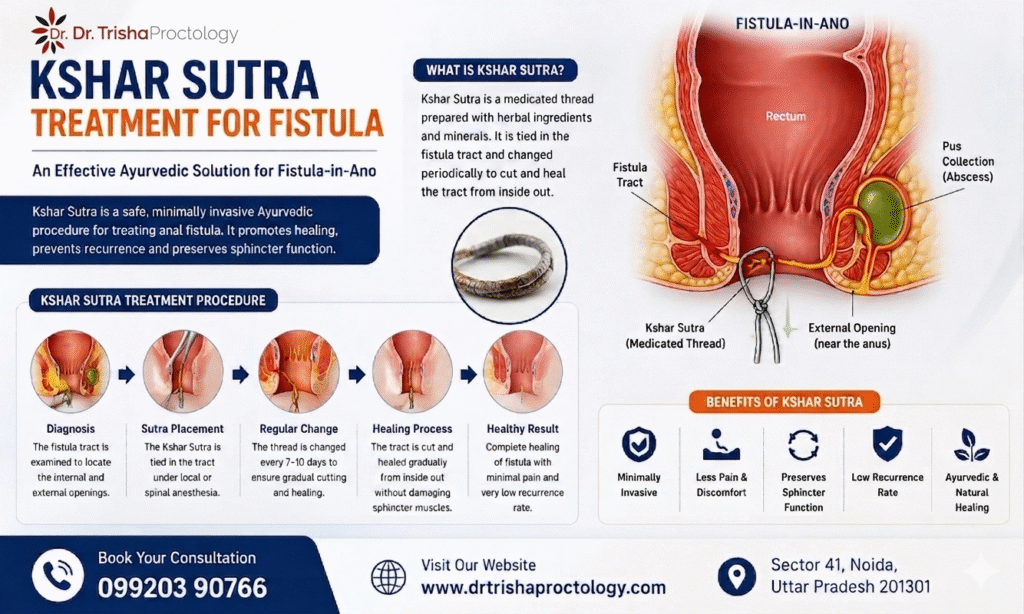
Kshar Sutra is an ancient Ayurvedic surgical technique that has been used for centuries in India for treating anorectal conditions, particularly anal fistula. Derived from the Sanskrit words “Kshar,” meaning caustic alkaline substance, and “Sutra,” meaning thread, Kshar Sutra is a medicated thread that is passed through the fistula tract and works by gradually cutting through and healing the tissue simultaneously. Understanding Kshar Sutra Treatment for Fistula: Procedure and Recovery can help patients make informed decisions about their treatment options. The procedure is minimally invasive, promotes gradual healing, and has been traditionally used to reduce the risk of recurrence. Recovery involves regular follow-up visits for thread changes, proper wound care, and maintaining good hygiene to support healing and improve outcomes.
In recent years, Kshar Sutra has gained attention as an alternative to conventional fistula surgery, particularly for complex fistulas involving the sphincter muscle. Dr. Trisha Rai, Noida’s trusted female proctologist, explains how Kshar Sutra works, its advantages and limitations, and how it compares to modern laser fistula treatment.
What is Kshar Sutra?
Kshar Sutra is a specially prepared medicated thread coated with a combination of herbal alkaline substances, most commonly Snuhi latex (Euphorbia neriifolia), Apamarga Kshara (Achyranthes aspera ash), and Haridra (turmeric). These substances give the thread caustic, antibacterial, and healing properties.
The thread is inserted into the fistula tract and tied in a loop connecting the internal and external openings. It works through three simultaneous mechanisms: the caustic coating gradually cuts through the tissue, the alkaline substances promote healing of the cut tissue, and the thread acts as a drain for any infection within the tract.
The thread is changed every 7–10 days. Each replacement involves tightening the thread slightly, progressively cutting through the fistula tract. Complete treatment typically takes 6–8 weeks depending on fistula complexity.
Who is Kshar Sutra Suitable For?
Kshar Sutra is particularly considered for transsphincteric fistulas, those that pass through a significant portion of the external sphincter muscle, where conventional surgical cutting of the sphincter carries unacceptable incontinence risk. By cutting through the sphincter extremely slowly and allowing simultaneous healing, Kshar Sutra theoretically minimizes this risk.
It may also be considered for patients who prefer an Ayurvedic treatment approach, those with complex high fistulas where standard surgical techniques are challenging, and cases where repeated conventional surgery has failed.
The Kshar Sutra Procedure Step by Step
Pre-Procedure Assessment Before Kshar Sutra placement, a thorough examination and fistulogram are performed to map the fistula tract accurately. Any active infection or abscess is drained and treated before the thread is placed.
Thread Preparation The Kshar Sutra thread is prepared by coating a surgical thread with Snuhi latex, drying it, and repeating this process 11–15 times. Apamarga Kshara is applied in subsequent coatings followed by Haridra. The final thread has a specific pH that makes it therapeutically active.
Thread Placement: Under local or short general anesthesia, a probe is passed through the fistula tract from the external opening to the internal opening. The Kshar Sutra thread is threaded through the probe and tied in a loop within the tract.
Weekly Thread Changes Every 7–10 days, the patient returns to the clinic for thread changing. The old thread is removed, and a fresh medicated thread is placed and tightened. This gradual tightening progressively cuts through the fistula tissue while simultaneously promoting healing of the cut edges.
Completion Treatment is complete when the thread has cut entirely through the fistula tract and the wound has healed. This typically takes 6–8 weeks for simple fistulas and longer for complex ones.
Advantages of Kshar Sutra for Fistula
Kshar Sutra offers the benefit of very gradual tissue division that allows simultaneous healing, theoretically minimizing sphincter damage. It is a time-tested technique with centuries of clinical use in India. It may be suitable for cases where conventional surgery carries high incontinence risk. It has a reasonable success rate for carefully selected cases when performed by experienced practitioners.
Limitations of Kshar Sutra
Despite its advantages in certain cases, Kshar Sutra has significant limitations that patients must understand. The treatment duration of 6–8 weeks with weekly clinic visits is a significant time commitment that impacts work and daily life. Pain and discomfort during the treatment period can be significant as the thread gradually cuts through tissue. It is not suitable for all fistula types; simple low fistulas are better treated with faster, less uncomfortable methods. The requirement for weekly visits creates logistical challenges for working patients. Results vary significantly depending on practitioner experience with the technique.
Kshar Sutra vs Laser Fistula Treatment: A Comparison
| Feature | Kshar Sutra | Laser Fistula Treatment |
| Treatment Duration | 6–8 weeks | Single session |
| Hospital Visits | Weekly | 1 procedure + follow-ups |
| Pain During Treatment | Moderate ongoing | Minimal anaesthesia used |
| Recovery Time | 6–8 weeks | 2–3 days |
| Sphincter Safety | Moderate gradual division | Excellent, no division |
| Suitable For | Complex high fistulas | Simple and selected complex |
| Modern Evidence Base | Limited | Strong and growing |
| Patient Convenience | Low | High |
FAQ
Q: Is Kshar Sutra painful?
A: The initial placement is performed under anesthesia. However, the ongoing cutting action of the thread between weekly visits causes moderate discomfort that varies between patients.
Q: How many visits are required for Kshar Sutra treatment?
A: Typically 6–10 weekly visits depending on fistula complexity. Each visit involves thread changing and takes approximately 15–30 minutes.
Q: Is Kshar Sutra better than laser for fistula?
A: For most cases, laser fistula treatment is more convenient, less painful, and faster. Kshar Sutra has specific advantages for complex high fistulas with significant sphincter involvement where laser is not suitable.
Q: Can Kshar Sutra be used for all types of fistula?
A: No. Kshar Sutra is most appropriate for transsphincteric fistulas. Simple low fistulas are better treated with faster options. Complex multi-tract fistulas may require other surgical approaches.
Q: Does Dr. Trisha Rai offer Kshar Sutra treatment?
A: Dr. Trisha Rai evaluates each fistula case individually and recommends the most appropriate treatment based on fistula type, complexity, and patient preference. Consultation will determine whether Kshar Sutra or laser treatment is the best option for your specific case.