
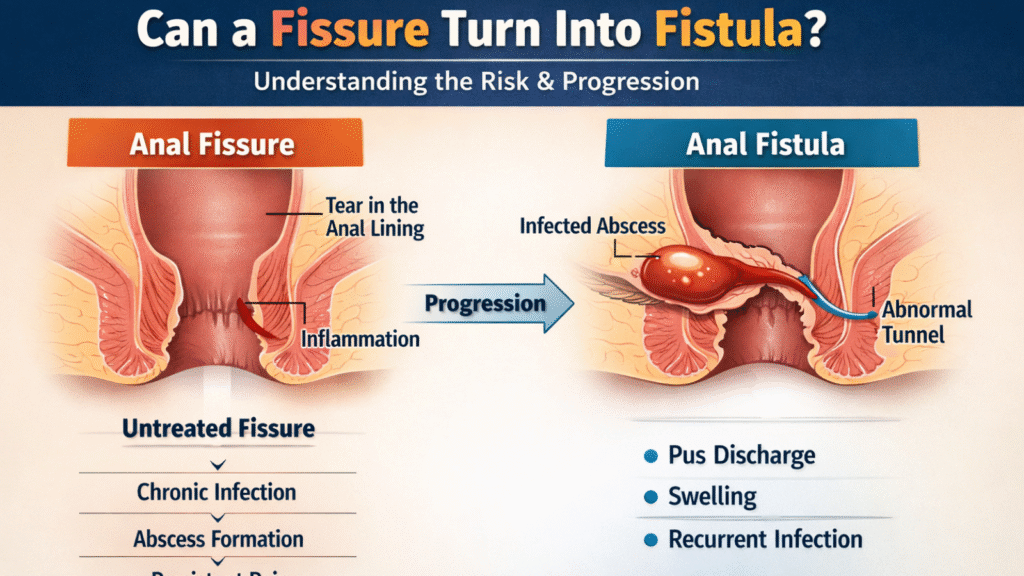
Many patients often ask, “Can a fissure turn into fistula?” The answer is generally no, but in some rare cases, complications can lead to related conditions if proper treatment is not taken on time.
Anal fissures and fistulas are common yet distressing anorectal conditions that affect many people. While a simple fissure rarely evolves directly into a fistula, untreated chronic cases can lead to complications like abscesses that may progress to fistulas.
Understanding Anal Fissures
An anal fissure is a small tear in the lining of the anus, often caused by hard stools, constipation, or straining during bowel movements. Symptoms include sharp pain during defecation and bright red blood on toilet paper. Most acute fissures heal within weeks with conservative measures like high-fiber diets, stool softeners, and warm sitz baths.
Chronic fissures persist beyond eight weeks, featuring a visible skin tag or sentinel pile. They result from repeated injury and sphincter muscle spasms that impair blood flow and healing. Without intervention, inflammation deepens.
What is an Anal Fistula?
An anal fistula forms a tunnel-like abnormal connection between the anal canal and the skin near the anus. It typically arises from an infected anal gland that creates an abscess, which then drains externally. Common causes include Crohn’s disease, prior surgeries, trauma, or untreated abscesses.
Symptoms involve persistent pus discharge, pain, swelling, and recurrent infections. Fistulas are classified as intersphincteric, transsphincteric, suprasphincteric, or extrasphincteric based on their path relative to sphincter muscles.
The Link: Does a Fissure Turn Into Fistula?
Direct transformation from fissure to fistula is rare without complications. A fissure does not inherently become a fistula, but chronic fissures can get infected, forming an abscess that bursts to create a fistula tract.
Risk factors amplifying this progression include underlying conditions like Crohn’s disease, where inflammation damages tissues, or surgeries like sphincterotomy for fissures that inadvertently affect glands. Ignoring symptoms heightens chances, as unhealed fissures foster bacterial growth and poor tissue repair.
Early treatment prevents escalation. Proper fissure management, topical nitrates, Botox injections, or surgery, promotes healing and averts abscess formation.
Risk Factors and Prevention
Key risks: constipation, diarrhea, childbirth trauma, and inflammatory bowel diseases. Prevention starts with fiber-rich diets, hydration, and prompt fissure care. Regular exercise aids bowel regularity.
Seek medical advice for fissures lasting over a week. Dr. Trisha Rai, a renowned piles specialist in Noida, emphasizes proactive care to avoid progression.
Treatment Options for Fissures
Conservative approaches succeed in 60-70% of cases. If ineffective, options include Botox for sphincter relaxation or lateral internal sphincterotomy, which boasts 95% success but risks incontinence.
Laser treatments offer precision for chronic fissures, minimizing damage. As a leading piles specialist doctor in Noida, Dr. Trisha Rai integrates these for optimal outcomes.
Managing Fistulas Effectively
Fistulas demand surgical intervention, as they rarely heal spontaneously. Fistulotomy suits simple cases, cutting the tract open for drainage, with 90% success but sphincter risks.
Advanced methods like seton placement, advancement flaps, or LIFT preserve continence in complex fistulas. For superior results, consider the best fistula treatment in Noida, where experts like Dr. Trisha Rai deliver tailored care.
Rise of Laser Fistula Treatment
Laser fistula treatment in Noida revolutionizes care with minimally invasive techniques. Procedures like FiLaC (Fistula-tract Laser Closure) insert a radial laser fiber to seal tracts from inside, sparing muscles.
Benefits: minimal pain, bloodless fields, same-day discharge, and low recurrence (under 10%). Laser Ablation (LAFT) and Endo Laser target tracts precisely, accelerating recovery to days versus weeks.
Dr. Trisha Rai pioneers laser fistula treatment in Noida, combining expertise with state-of-the-art tech for faster healing.
Why Choose Top Hospitals?
The best hospitals for fistula treatment prioritize advanced proctology, experienced surgeons, and patient privacy. Facilities in Noida offer comprehensive diagnostics like MRI fistulography and endoanal ultrasound.
Look for accreditation, success rates above 90%, and multidisciplinary teams. Dr. Trisha Rai’s clinic stands out among the best hospitals for fistula treatment, focusing on personalized, minimally invasive solutions.
Living with These Conditions
Post-treatment, maintain hygiene, have a high-fiber intake, and follow up to prevent recurrence. Most patients resume normal activities swiftly, especially with laser methods.
As a trusted piles specialist doctor in Noida, Dr. Trisha Rai guides patients through recovery, ensuring long-term relief.
When to Consult Dr. Trisha Rai
Persistent pain, bleeding, or discharge warrants immediate evaluation. Dr. Trisha Rai offers the best fistula treatment in Noida, specializing in laser fistula treatment in Noida. Book a consultation for expert care at one of the best hospitals for fistula treatment.
FAQ
Can a fissure turn into a fistula if untreated?
Rarely directly, but chronic fissures can lead to abscesses that form fistulas. Early treatment prevents this.
What is the best fistula treatment in Noida?
Laser-based options like FiLaC provide high success with minimal downtime. Dr. Trisha Rai excels here.
How effective is laser fistula treatment in Noida?
Over 90% success, with quicker recovery and low recurrence compared to traditional surgery.
Which are the best hospitals for fistula treatment?
Those with proctology specialists, advanced lasers, and high patient ratings, like Dr. Trisha Rai’s facility.
Who is the top piles specialist doctor in Noida for fistulas?
Dr. Trisha Rai, renowned for laser expertise and patient-centered care.