
A fistula-in-ano is an abnormal tunnel connecting the anal canal to the skin near the anus, usually developing after an abscess or chronic infection. Patients often experience persistent discharge, pain, or recurrent infections. In my OPD, fistulas are commonly seen in patients with previous abscesses, chronic constipation, or inflammation.
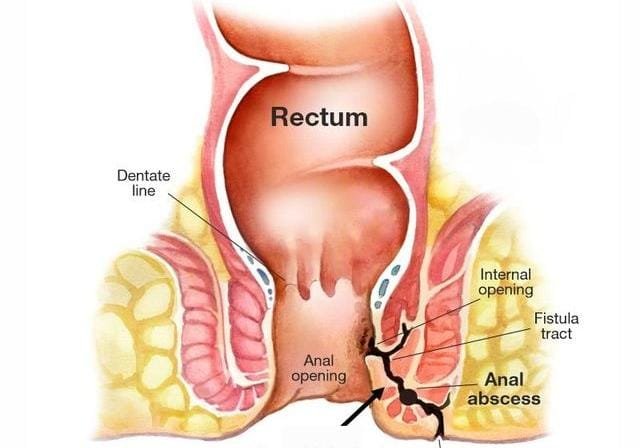
Simple Fistula: Single, straightforward tract; easier to treat.
Complex Fistula: Multiple or branching tracts; often require advanced planning.
High Fistula: Involves significant sphincter muscle; requires sphincter-preserving techniques.
Take the first step toward expert diagnosis and personalised treatment. Dr. Rai’s expertise ensures accurate assessment and the right solution for your condition.
Accurate diagnosis ensures proper surgical planning and reduces recurrence risk.
Important: While these measures help relieve symptoms, a fistula cannot heal completely without surgical or laser treatment. Conservative care alone is not curative.
For simple fistulas, the tract is surgically opened to allow natural healing. High success rate while preserving sphincter function.
A thread or rubber seton is placed in complex/high fistulas to drain infection gradually and protect sphincter muscles.
Used in selected complex fistulas to relieve sphincter spasm and promote healing. Both techniques are day-care procedures with minimal discomfort.
Distal ligation: The external opening of the fistula tract is tied off to prevent infection and control drainage.
Proximal laser: A diode laser fiber is inserted along the tract from inside to coagulate and close it.
Minimally invasive with faster recovery and reduced post-operative pain.
Uses a radial-emitting laser fiber to seal the entire tract uniformly from inside.
Can treat simple and complex fistulas, including branching tracts.
Preserves sphincter function and promotes faster healing.
For complex fistulas, the tract is carefully ligated to prevent recurrence while preserving continence.
I provide a patient-focused, comprehensive approach for fistula-in-ano. Each plan combines dietary guidance, hygiene advice, Ayurvedic support, and advanced procedures such as fistulotomy, seton placement, lateral internal sphincterotomy, DLPL (distal ligation + proximal laser), FiLaC, or LIFT. The goal is permanent healing, minimal discomfort, and preservation of sphincter function for normal bowel control.
Take the first step toward expert diagnosis and personalised treatment. Dr. Rai’s expertise ensures accurate assessment and the right solution for your condition.
Everything you need to know before starting your treatment journey.
Modern Anorectal & General Surgery You Can Trust. With expertise in advanced laser-assisted procedures, Dr. Trisha focuses on minimally invasive care.
Copyright 2025. All Rights Reserved. Developed by Wand Weaver.
Copyright 2025. All Rights Reserved.
Developed by Wand Weaver.
WhatsApp us