
Introduction
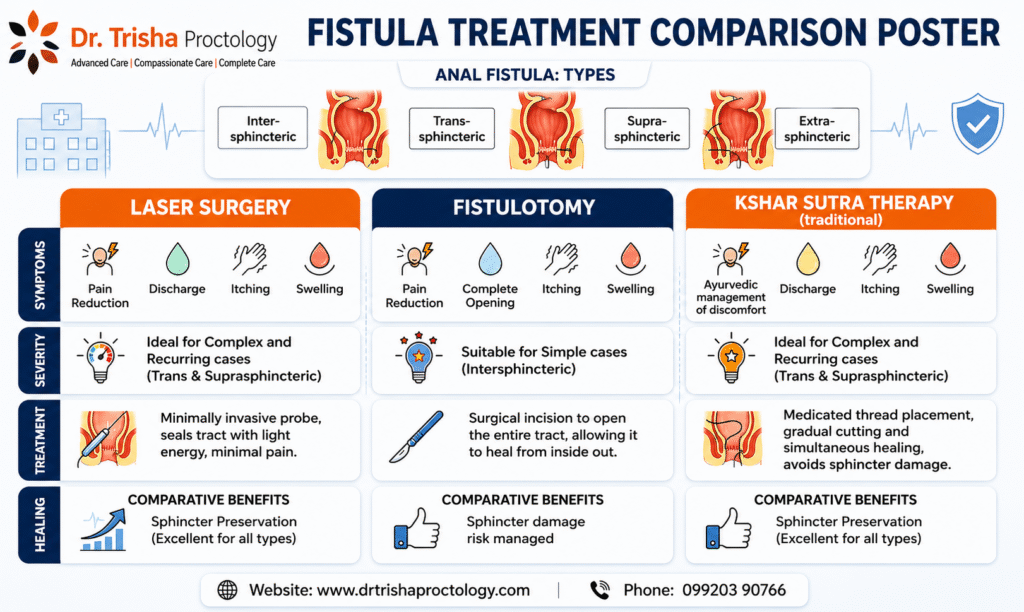
Anal fistula is not a single uniform condition. It encompasses a wide spectrum of complexity, from simple, straightforward tracts that are easily treated to complex, multi-branching passages that require advanced surgical planning and technique. How to Recognize and Treat the Different Types of Fistulas is essential for accurate diagnosis, appropriate treatment selection, and realistic recovery expectations.
Dr. Trisha Rai, Noida’s trusted female proctologist, explains howto recognizee the different types of anal fistulas, what symptoms each type causes, and which treatment options deliver the best outcomes for each.
What is an anal fistula?
An anal fistula is an abnormal tunnel connecting the inside of the anal canal to the skin surrounding the anus. It almost always develops as a result of an anal abscess, a collection of infected pus that has not healed completely from the inside. The infected gland within the anal canal remains the source of ongoing infection, and a tract forms between this internal source and the skin surface.
The specific characteristics of each fistula, its path through the tissue, its relationship to the sphincter muscles, and whether it has secondary branches determine its type and the most appropriate treatment approach.
Classification of Anal Fistulas
Parks Classification: The Standard System
The most widely used classification for anal fistulas is the Parks Classification, developed by Sir Alan Parks in 1976. It categorizes fistulas based on their relationship to the internal and external anal sphincter muscles.
Type 1 Intersphincteric Fistula
What it is: The fistula tract passes between the internal and external sphincter muscles through the intersphincteric plane.
How common: The most common type, accounting for approximately 70% of all anal fistulas.
How to recognize it: Patients typically present with a relatively straightforward external opening close to the anal verge. Pain is present but may be less severe than with higher fistulae. Discharge is consistent. The external opening is usually within 2–3 cm of the anal opening.
Treatment: Intersphincteric fistulas are generally the most straightforward to treat. Fistulotomy, surgically laying open the tract, is highly effective because minimal sphincter muscle is involved. Laser fistula treatment is an excellent minimally invasive alternative that achieves complete tract obliteration with same-day discharge.
Type 2 Transsphincteric Fistula
What it is: The fistula tract passes through both the internal and external sphincter muscles, crossing the intersphincteric plane to reach the skin.
How common: Accounts for approximately 25% of all anal fistulas, the second most common type.
How to recognize it: The external opening is typically located further from the anal verge than intersphincteric fistulas. Patients often have a history of a large or deeply situated abscess. Pain can be more significant. There may be a horseshoe pattern if the tract curves around to both sides.
Treatment: Transsphincteric fistulas require careful surgical planning because cutting through the external sphincter carries incontinence risk. Sphincter-preserving techniques are prioritized, including LIFT (Ligation of Intersphincteric Fistula Tract), VAAFT, laser obliteration, advancement flap repair, or seton placement for staged treatment. Kshar Sutra may be considered for suitable cases.
Type 3 Suprasphincteric Fistula
What it is: The fistula tract passes above the entire sphincter complex over the top of the puborectalis muscle before descending to the skin.
How common: Less common, accounting for approximately 5% of cases.
How to recognize it: These fistulas typically present with a high external opening located further from the anal verge. They are often associated with a deep ischioanal abscess. Symptoms include significant pain, substantial discharge, and possible recurrent infections. A pre-operative MRI fistulogram is particularly important for mapping these tracts accurately.
Treatment: Suprasphincteric fistulas are among the most challenging to treat due to the significant volume of sphincter muscle involved. Sphincter-preserving approaches are essential. VAAFT, advancement flap, and seton placement are the primary options. These cases require highly experienced specialist management.
Type 4 Extrasphincteric Fistula
What it is: The fistula tract passes completely outside the sphincter complex, from the skin through the ischiorectal fossa and levator ani muscle directly into the rectum.
How common: The rarest type, accounting for less than 5% of cases.
How to recognize it: These fistulas are often associated with specific underlying conditions, including Crohn’s disease, pelvic inflammatory disease, foreign body trauma, or prior pelvic surgery. They typically present with a high external opening and may have an unusual location or orientation. Investigation of the underlying cause is mandatory.
Treatment: Extrasphincteric fistulas require the most complex surgical management. Treatment of the underlying condition is the priority. Surgical options are tailored to the individual case and may involve a staged approach. These cases require referral to an experienced specialist like Dr. Trisha Rai for comprehensive management.
Additional Fistula Classifications
Simple vs Complex Fistula
Beyond the Parks classification, fistulas are broadly categorized as simple or complex based on treatment considerations.
Simple fistulas are low, involve minimal sphincter muscle, have a single straight tract, and are not associated with underlying conditions. They respond well to straightforward surgical treatment with excellent outcomes and low recurrence rates.
Complex fistulas involve significant sphincter muscles, have multiple tracts, are associated with conditions like Crohn’s disease, have recurred after previous treatment, or occur in patients with special considerations like previous incontinence or previous pelvic radiation. They require advanced surgical planning and specialist expertise.
Horseshoe Fistula
A horseshoe fistula is a specific pattern where the fistula tract curves around the anal canal either anteriorly or posteriorly, connecting to both sides. It typically arises from a posterior midline internal opening and extends to both left and right sides. These fistulas require careful surgical identification of the primary tract and all secondary extensions for complete treatment.
How Dr. Trisha Rai Diagnoses Fistula Type
Accurate fistula classification requires a combination of clinical assessment and diagnostic imaging. Dr. Trisha Rai’s diagnostic approach includes thorough history taking and examination to identify the external opening location; probe examination under anesthesia to trace the primary tract; MRI fistulogram for complex cases to map all tract branches and their relationship to the sphincter; and VAAFT for internal visualization of the complete tract before treatment.
Treatment Summary by Fistula Type
| Fistula Type | Primary Treatment Options |
| Intersphincteric | Laser obliteration, Fistulotomy |
| Transsphincteric | LIFT, VAAFT, Laser, Advancement Flap, Seton |
| Suprasphincteric | VAAFT, Advancement Flap, Seton |
| Extrasphincteric | Staged surgery, Underlying condition treatment |
| Horseshoe | VAAFT, Staged Fistulotomy, Seton |
| Complex/Recurrent | MRI-guided VAAFT, Advancement Flap |
FAQ
Q: How do I know which type of fistula I have?
A: Only a specialist examination and appropriate imaging can accurately classify your fistula. Consult Dr. Trisha Rai for thorough diagnosis including MRI fistulogram if needed.
Q: Is laser treatment suitable for all types of fistula?
A: Laser obliteration is most effective for intersphincteric and selected transsphincteric fistulas. Complex high fistulas may require VAAFT or other sphincter-preserving surgical techniques.
Q: Why does fistula type affect treatment choice?
A: The fistula’s relationship to the sphincter muscle is the critical factor. Treatments that work well for simple low fistulas may risk incontinence when applied to high complex fistulas. Treatment must be tailored to type.
Q: Can a fistula change type over time?
A: The primary tract classification does not change, but untreated fistulas can develop secondary tracts and extensions that make them progressively more complex and harder to treat.
Q: What is the most difficult type of fistula to treat?
A: Extrasphincteric and complex suprasphincteric fistulas are the most challenging due to their high position relative to the sphincter and frequent association with underlying conditions like Crohn’s disease.
Q: Does Dr. Trisha Rai treat all types of fistula?
A: Yes. Dr. Trisha Rai manages the complete spectrum of anal fistulas from simple intersphincteric cases to complex recurrent fistulas using the full range of modern surgical and laser techniques.